QEMU vs Renode for Cortex-M Firmware Simulation
Renode excels at peripheral depth and multi-node simulation where QEMU falls short.
Cortex-M is the workhorse architecture of the embedded world: over 80 vendors license the core, and roughly 100 billion devices running some variant of it were in the field as of 2021. That scale creates a constant pressure on firmware teams to test code before silicon shows up, run regression suites in CI, and check behavior across board variants without a bench full of hardware. QEMU and Renode both answer that pressure, but they answer it in different ways, and picking the wrong one for a given job doesn't just slow you down, it can hide bugs for months.
What each tool is and what it was built to do
QEMU started as Fabrice Bellard's general-purpose machine emulator and is now maintained by a large team led by Peter Maydell. It's written in C, and the current stable release is 11.1.1, from August 27, 2026. Its job, from day one, has been breadth: emulate x86, ARM, PowerPC, MIPS, and a long list of other processor families, on nearly any host you can compile it for. Cortex-M support exists inside that broader project. It is not the reason QEMU exists.
Renode comes from a narrower brief. Antmicro built it specifically as a virtual development tool for multi-node embedded networks, wired and wireless alike. It's written in C#, targets.NET 6.0 and up (with Mono support for older.NET 4.6.2 setups), and the current release, dated September 7, 2026, carries a version number in the mid-1.x range. Where QEMU treats Cortex-M as one target among dozens, Renode treats peripheral accuracy and CI integration as the whole point. The stated goal is to let teams develop, test, debug, and simulate unmodified IoT firmware at scale, and that goal shapes almost every design choice downstream.
CPU emulation: what both tools get right at the core
QEMU's instruction-level emulation runs on TCG, the Tiny Code Generator, which does dynamic binary translation: guest instructions get converted into host machine code on the fly, batched into Translation Blocks that run until a branch or an exception vector interrupts them. For Cortex-M work this is the only path available; KVM, which QEMU uses to run guest code natively on matching hardware, doesn't apply when you're emulating an ARM target on an x86 host. So it's TCG or nothing, and TCG's Cortex-M coverage is genuinely solid, spanning Armv6-M through Armv8.1-M along with extensions like FP, MPU, PXN, RAS, and the Security extension.
Renode's CPU support runs wider across architecture families, including ARMv7 and ARMv8 Cortex-A, Cortex-R, and Cortex-M cores, plus RISC-V, SPARC, POWER, Xtensa, and MSP430X. Timing discipline is where Renode tries to win. Its real edge at the core level is timing discipline: Renode's timing model is designed to keep virtual time consistent across runs, which matters enormously once you start running the same test in CI a thousand times and expect the same result each run.
Board support and memory map fidelity: where the real gaps appear
QEMU's best-supported Cortex-M boards are Arm's own reference platforms, not vendor silicon. The MPS2 and MPS3 families are covered in depth, along with Musca variants and a popular educational board. That makes sense: these are Arm's reference designs, built to be emulated, and Arm has every incentive to keep QEMU's model of them current.
Vendor chips tell a different story. QEMU 11.0.3 ships exactly five STM32 machines: b-l475e-iot01a, netduino2, netduinoplus2, olimex-stm32-h405, and stm32vldisco. Notice what's missing: no STM32F4 Discovery board, despite it being one of the most common STM32 dev kits in circulation.
A case study from Veecle makes the consequence concrete. A bare-metal STM32F4 ELF binary, run against QEMU's closest available proxy (netduinoplus2, built around an STM32F405), locked up before it ever reached main. The cause traced back to memory, not code: QEMU correctly modeled the STM32F405's 128 KB of contiguous SRAM, but the firmware's linker script had been written assuming 192 KB. The very first stack push landed outside mapped memory, triggered a HardFault, and the HardFault handler itself faulted trying to run, which is a lockup by definition. QEMU was right. The discrepancy surfaced a real memory map mismatch in the firmware that a less strict environment had not caught. That gap costs a team real time once it appears on physical hardware instead of in a simulator built to catch it early.
Peripheral simulation depth: the axis that separates the tools in practice
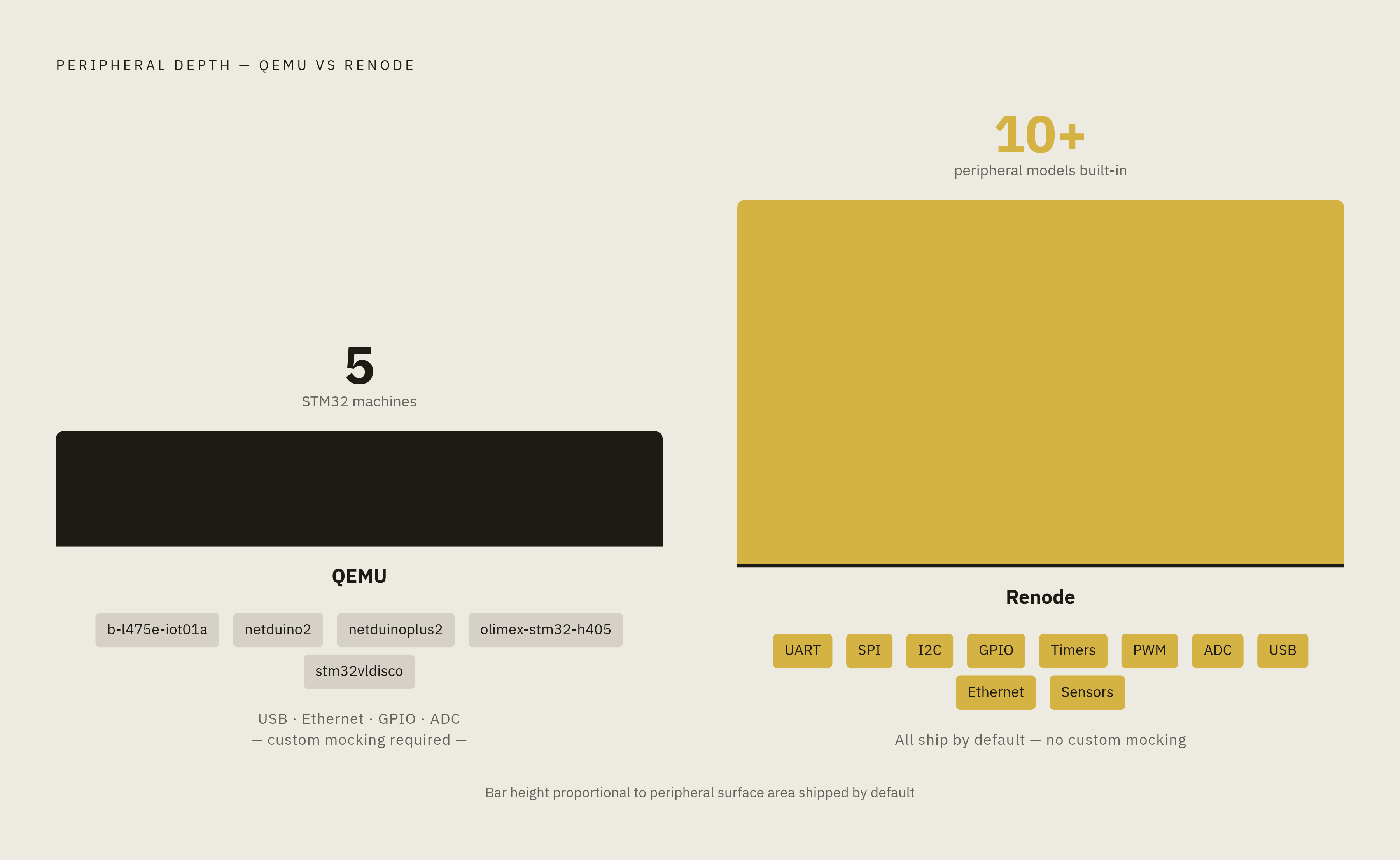
This is where the two tools diverge hardest, and it's the difference most likely to matter day to day. QEMU models basic timers and basic interrupts reasonably well, but more elaborate peripherals, USB, Ethernet, GPIO, and similar, tend to require custom mocking layers built by the team using it. It's common to find an MCU emulated in QEMU with working USART support but no timer or ADC model. That's not a defect so much as a consequence of QEMU's breadth-first design: nobody can model every peripheral on every chip QEMU supports, so coverage lands unevenly.
Renode's peripheral catalog runs deeper by default: UART, SPI, I2C, GPIO, timers, PWM, ADC, USB, and Ethernet all have models, and the framework extends past the MCU itself to simulate external devices like sensors sitting on the bus. Under the hood, a peripheral in Renode is just a C# object implementing a register interface, and teams can write their own in C# or Python when the built-in catalog doesn't cover a part.
Having a peripheral modeled isn't the same as having it modeled correctly, though. Renode 1.16.1 offers a clean example: the standard Cortex-M cycle-counting profiling sequence, set TRCENA in DEMCR, enable CYCCNTENA in DWT_CTRL, then write zero to DWT_CYCCNT, fails partway through with "WriteDoubleWord to non existing peripheral at 0xE0001004." The DWT cycle counter simply wasn't implemented in that release, so any profiling code relying on it silently stops working, or rather, not silently: it throws a specific, readable error, which is its own kind of useful.
Multi-node and heterogeneous SoC simulation: where Renode has no QEMU equivalent
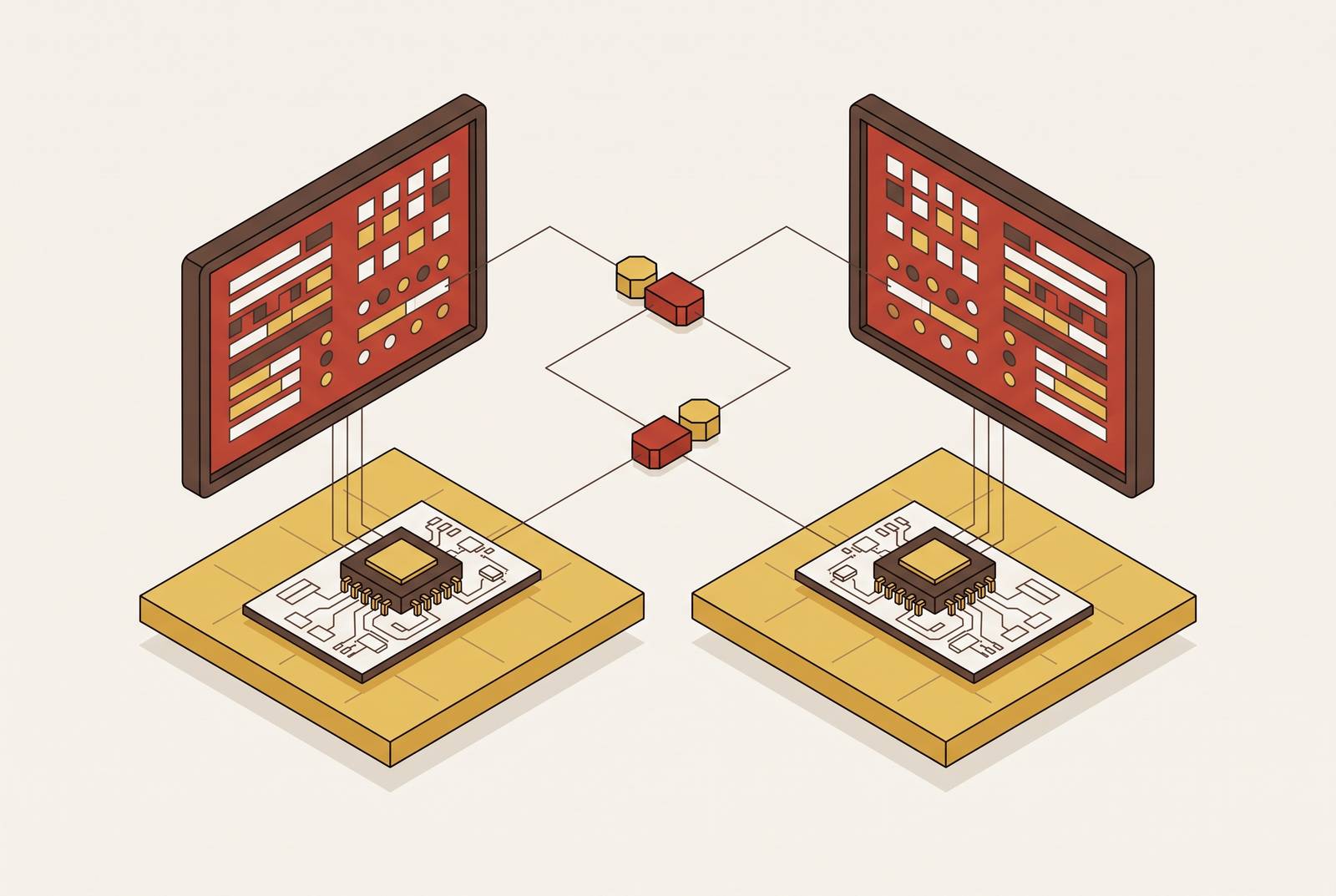
Renode's founding premise was multi-node simulation, and this is the one category where QEMU doesn't really offer a comparable feature. Running several communicating devices, wired or wireless, inside one simulation session is built into Renode's core design rather than bolted on afterward.
That extends to heterogeneous SoCs, chips that mix application cores with microcontroller cores on the same die. Renode can simulate a system containing both Cortex-A and Cortex-M cores running together, which matters directly for any product built around a Linux-capable applications processor paired with an embedded Cortex-M coprocessor. NXP's i.MX 8M Plus is a working example: four Cortex-A53 cores and one microcontroller-class core, alongside an ML accelerator, 2D/3D graphics, Ethernet, USB, and CAN, all inside one Renode simulation.
Toyota's RAMN project shows what this looks like outside a vendor reference design. RAMN is an open-source, multi-node STM-based testbed that communicates over CAN and CAN-FD, and Antmicro added Renode support for it. With that support in place, RAMN can run without the physical PCB on the bench, and it can connect to CARLA, the open-source automotive simulator, opening the door to testing automotive firmware against simulated driving scenarios rather than a static test rig.
CI/CD integration ergonomics: scripting, Robot Framework, and what "works out of the box" means
QEMU's CI story leans on its monitor interface, which is scriptable, but most teams end up wrapping it in shell scripts or Python to get a usable test harness. That's more boilerplate up front. What QEMU offers in exchange is an installation story that's hard to beat: one apt install or brew install, no signup, no license server, running in minutes on almost any machine.
Zephyr's qemu_cortex_m3 board target shows what that ubiquity buys you. It emulates the TI LM3S6965, and Zephyr's own documentation is upfront that it "makes no claims about its suitability for use with an actual ti_lm3s6965 hardware system." It isn't a hardware stand-in, it's a fast, zero-friction execution environment for running a test suite, and that's exactly the job it's meant to do. The emulation itself covers a Cortex-M3 CPU along with a set of common peripherals, enough surface area to run a meaningful chunk of firmware smoke tests without ever touching a board.
Renode's CI path is more structured from the start. Antmicro maintains renode-test-action, a dedicated GitHub Action that sets up Renode automatically and runs tests written in Robot Framework, using a keyword library built specifically for driving Renode simulations. It's more setup investment than a bare apt install, but the payoff is a test framework designed around simulation from the outset rather than adapted to it.
What each tool surfaces when firmware goes wrong
Both tools speak the GDB remote serial protocol, so ordinary breakpoint-and-step debugging works the same way in either one. Past that baseline, the two tools show you very different amounts of information when firmware actually breaks.
QEMU's debugging surface is GDB plus its own monitor, and when a fault hits, QEMU reports fault information and stops execution. That's minimal, but it's accurate: in the Veecle STM32F4 case, that plain register dump was enough to correctly diagnose the stack pointer landing outside mapped SRAM. No embellishment, just the facts needed to find the bug.
Renode gives firmware developers more to work with. Its interactive monitor CLI, execution tracing, and an Execution Tracer that can log program counter values to help trace execution flow, all add up to a richer picture of what firmware is doing moment to moment. Unhandled peripheral access warnings log the specific register name involved, which is how the DWT_CYCCNT gap surfaced as a clear, readable error rather than a wrong value nobody noticed. The monitor CLI also lets a developer inspect machine state interactively, catching mismatches on inspection rather than waiting for them to surface as a hard fault deeper in execution.